Interpret speech
Spoken input is represented as a compact capsule carrying the intended message.
A transport-agnostic voice architecture.
T3E97 converts speech into encrypted intent capsules, then delivers them through the available communication transport. The architecture is independent of the medium.
What it does
T3E97 is One Island’s artificial intelligence telecom architecture for voice communication. It converts spoken input into compact intent capsules, protects the message, and passes it to a transport layer for delivery.
Separating message creation from transport means T3E97 is not tied to one network or communication medium.
Architecture
Spoken input is represented as a compact capsule carrying the intended message.
The capsule is encrypted and prepared for delivery. No continuous audio stream is sent.
The transport layer carries the capsule and is independent of the T3E97 voice architecture.
Resilience
Eliminating the “Cliff Effect” in Commercial Cellular and Non-Terrestrial Networks.
Conventional telecommunications operate on a binary framework: you stream continuous audio, or the call fails. When mobile devices move past the cell edge into rural terrain, dense foliage, or extreme weather, standard network streams drop off a cliff.
T3E97 introduces Dynamic Link Resiliency (DLR). Instead of fighting the physics of degraded channels, the protocol acts as an embedded network safety net:
During periods of stable connectivity, the T3E97 engine operates silently in the background, utilizing the local device NPU to securely map the user’s voice biometrics without ever leaving the hardware edge.
The moment the host network crosses a packet-loss or signal-to-noise ratio threshold, the system executes an instantaneous, hitless transition. It drops the heavy streaming waveform and engages T3E97.
Voice capture is translated into hyper-compressed linguistic tokens and emotion markers, slipping through connection windows as tight as 200 bps. The receiving terminal extracts the data packets from a local playback queue, synthesizing an unbroken, perfectly fluid, natural voice clone.
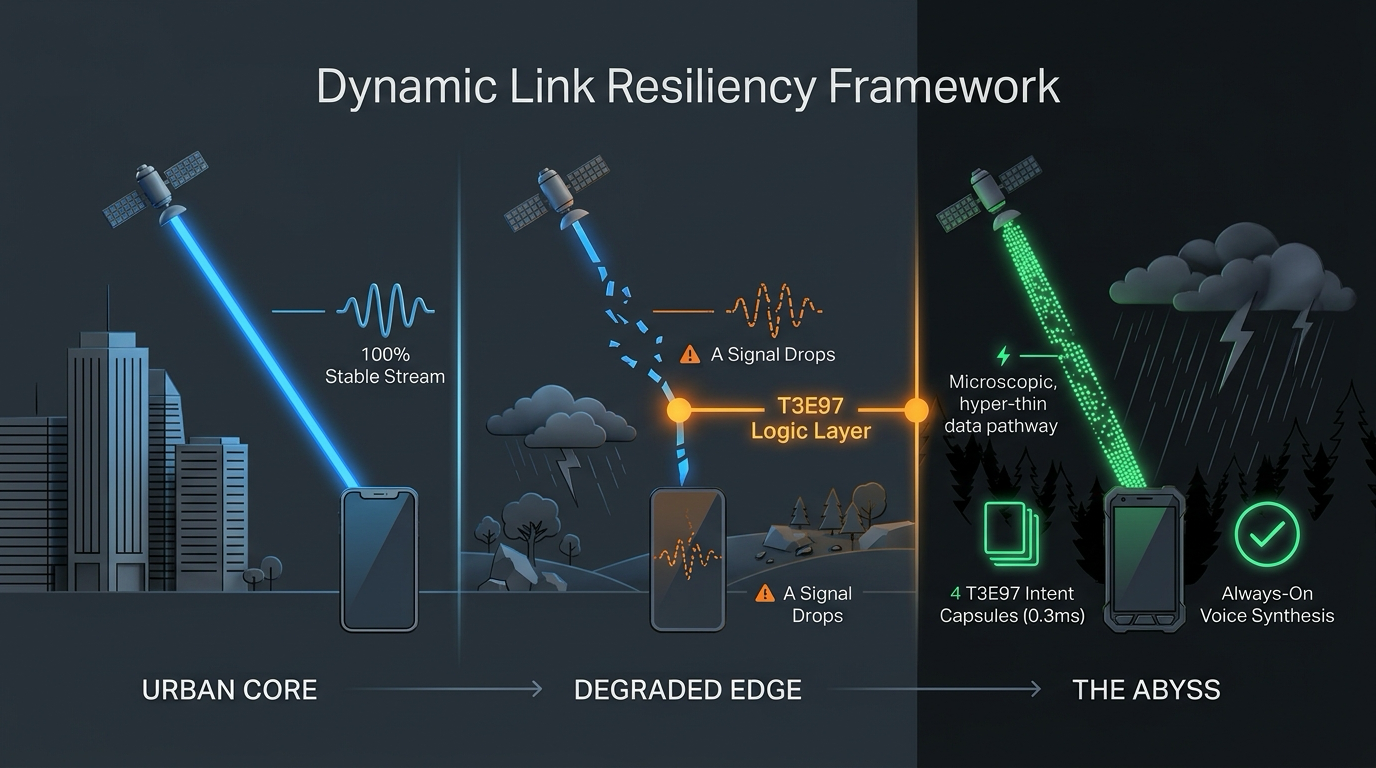
The Result: The network connection can run on absolute fumes, but the human voice line never drops.
Device integration
Satellite communicators, handheld navigators, and mesh radios can send short messages. With T3E97, they can carry voice.
Most of these devices were built for text. They can move a short message across a weak link, but they cannot carry a voice call. T3E97 sends a compact, encrypted intent capsule instead of audio, so any device that can deliver a short message can deliver a voice message.
The user holds a button and speaks. T3E97 turns the speech into a message the device already knows how to send.
Manufacturers and app developers add T3E97 as a software layer. The device keeps its own radio, network, and user experience.
The receiving device rebuilds the message as natural speech. Both ends only need to speak T3E97.
Phantom already does this today over mesh radio. T3E97 is built so the same approach can run on other devices and networks.
Talk to us about integrationAvailable now / Phantom
Phantom is a working application of T3E97. It demonstrates on-device speech processing and encrypted voice messaging without cell service, internet, or cloud servers. Phantom is one implementation of the architecture, not its limit.
Phantom details and downloadFor teams and developers
